History
A people without the knowledge of their past history, origin and culture is like a tree without roots.
- Marcus Garvey
History Curriculum Intent Statement
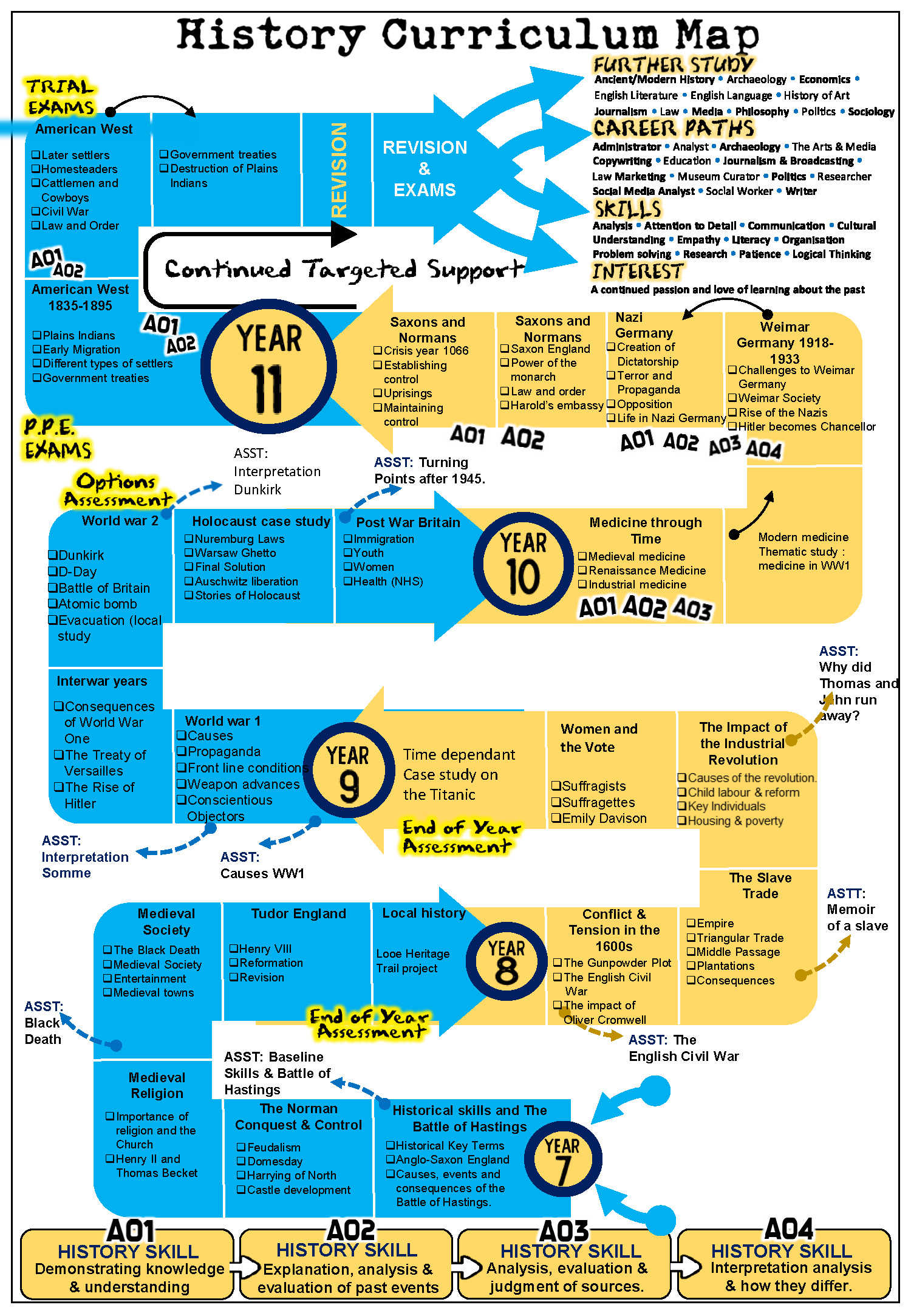
Our History curriculum is designed to inspire curiosity, develop critical thinking, and empower students to understand the complexity of the past and its influence on the present. Through a carefully sequenced journey from Year 7 to Year 11, we aim to ensure that every learner:
-
Thinks deeply about big ideas: Students explore fundamental historical concepts such as Perspectives, Continuity and Change, Cause and Effect, and Significance. These concepts underpin all topics, enabling learners to make connections across time and place rather than viewing history as isolated events.
-
Understands the human story: History is not just about dates and battles; it is about people, power, and ideas. Our curriculum encourages students to consider multiple viewpoints, challenge assumptions, and appreciate the diversity of experiences that have shaped societies.
-
Builds disciplinary knowledge: Students learn how historians work—evaluating evidence, constructing arguments, and questioning interpretations. This disciplinary approach equips them with transferable skills for life beyond school.
-
Engages with local, national, and global narratives: From “Would you survive the Middle Ages?” to “How one bullet caused 20 million deaths”, our topics are chosen to spark interest and provide relevance. We connect local history, such as Cornwall’s mining and smuggling heritage, with national and global developments, fostering a sense of identity and perspective.
-
Develops chronological understanding and cultural literacy: Our curriculum is ambitious and cumulative. Beginning with migration and monarchy in Year 7, moving through revolution, empire, and social change in Year 8, and culminating in global conflict and ideological struggle in Year 9, students gain a coherent understanding of how the past shapes the present. At GCSE, this knowledge is deepened through thematic and depth studies.
Curriculum Pathways
Focused Curriculum Contextual Routines
- Reading
- Frayer Model
- Visualiser
- Think out loud
- Cold Calling
- Mini-whiteboards
- Turn and talk
- Think/pair/share