Drama
It's about what it is to be human in the safety of the made event.
- Dorothy Heathcote
Drama Curriculum Intent Statement
At Looe Community Academy, our Drama curriculum is designed to nurture creativity, build confidence, and develop critical thinkers who can communicate ideas with clarity and imagination. We believe Drama is both a practical art form and an academic discipline, so our curriculum connects Making, Performing, and Responding, enabling students to understand how theatre reflects and shapes human experience.
Central to our curriculum are the big ideas of Audience, Style, Confidence, Physical Skill, and Vocal Skill. These underpin every unit, helping students explore how performance choices create meaning and impact. Through these lenses, learners develop technical and expressive skills, work collaboratively, and engage critically with texts and performance styles.
We aim to provide high challenge with low threat, creating a culture where students feel safe to take creative risks and develop their own voice. Students encounter a wide range of theatrical styles—from devising and physical theatre to Shakespeare and political theatre—learning to question, interpret, and respond with originality. They study dramatic conventions, practitioner techniques, and cultural contexts, engaging with Drama as a serious academic subject.
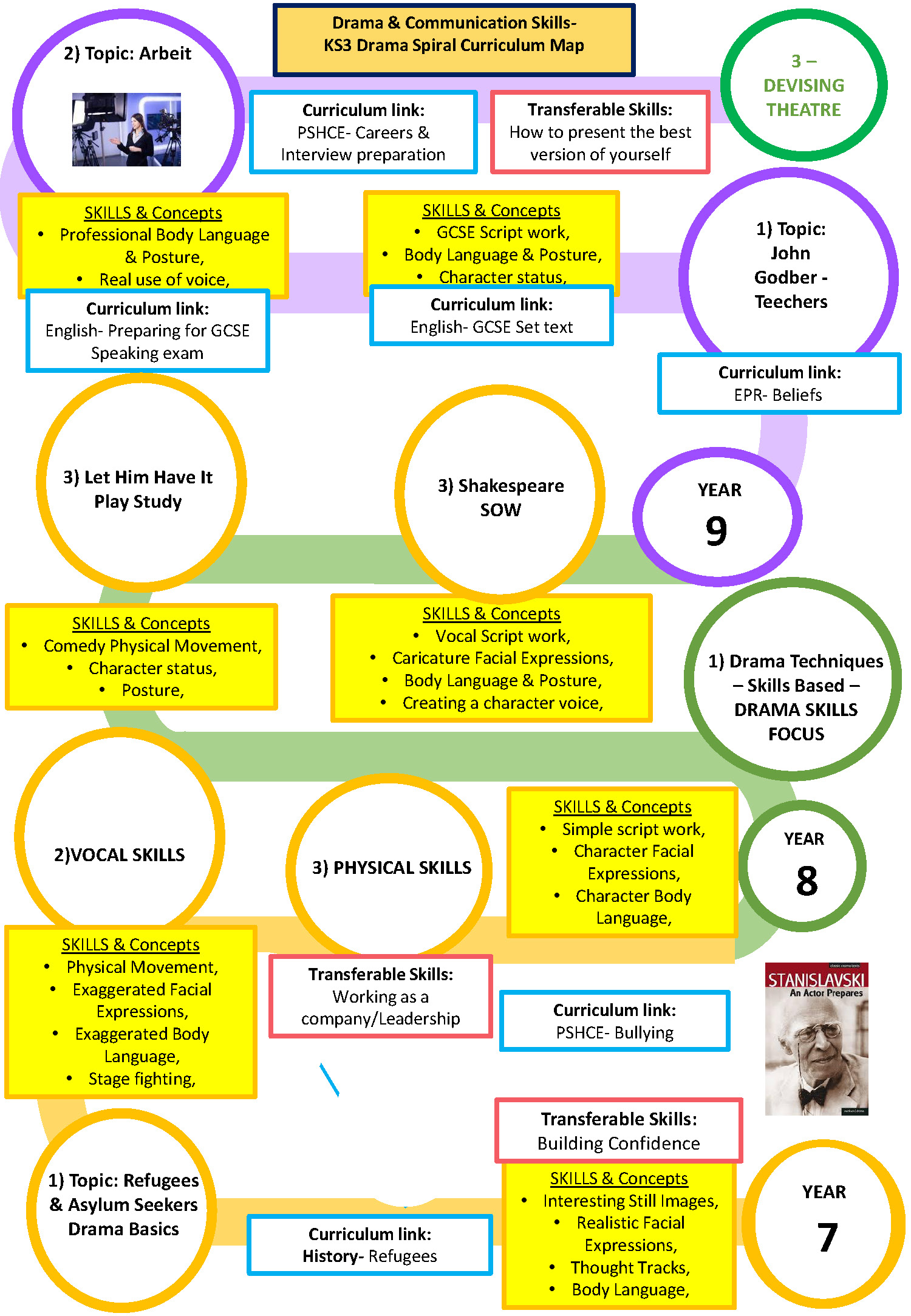
Our curriculum is deliberately spiralled, revisiting key concepts at increasing levels of complexity:
-
Year 7: Students build foundations in ensemble work, devising, and physical skills. They learn basic stagecraft, mime, and vocal techniques, exploring Shakespeare through practical activities.
-
Year 8: Challenge increases as students explore melodrama, political theatre, and platform theatre. They apply techniques such as breaking the fourth wall and marking the moment, developing confidence in performance and reflection.
-
Year 9: Students deepen their understanding through satire, multi-role performance, and physical theatre inspired by Frantic Assembly. They refine vocal and physical skills and engage in extended analysis using subject-specific terminology.
-
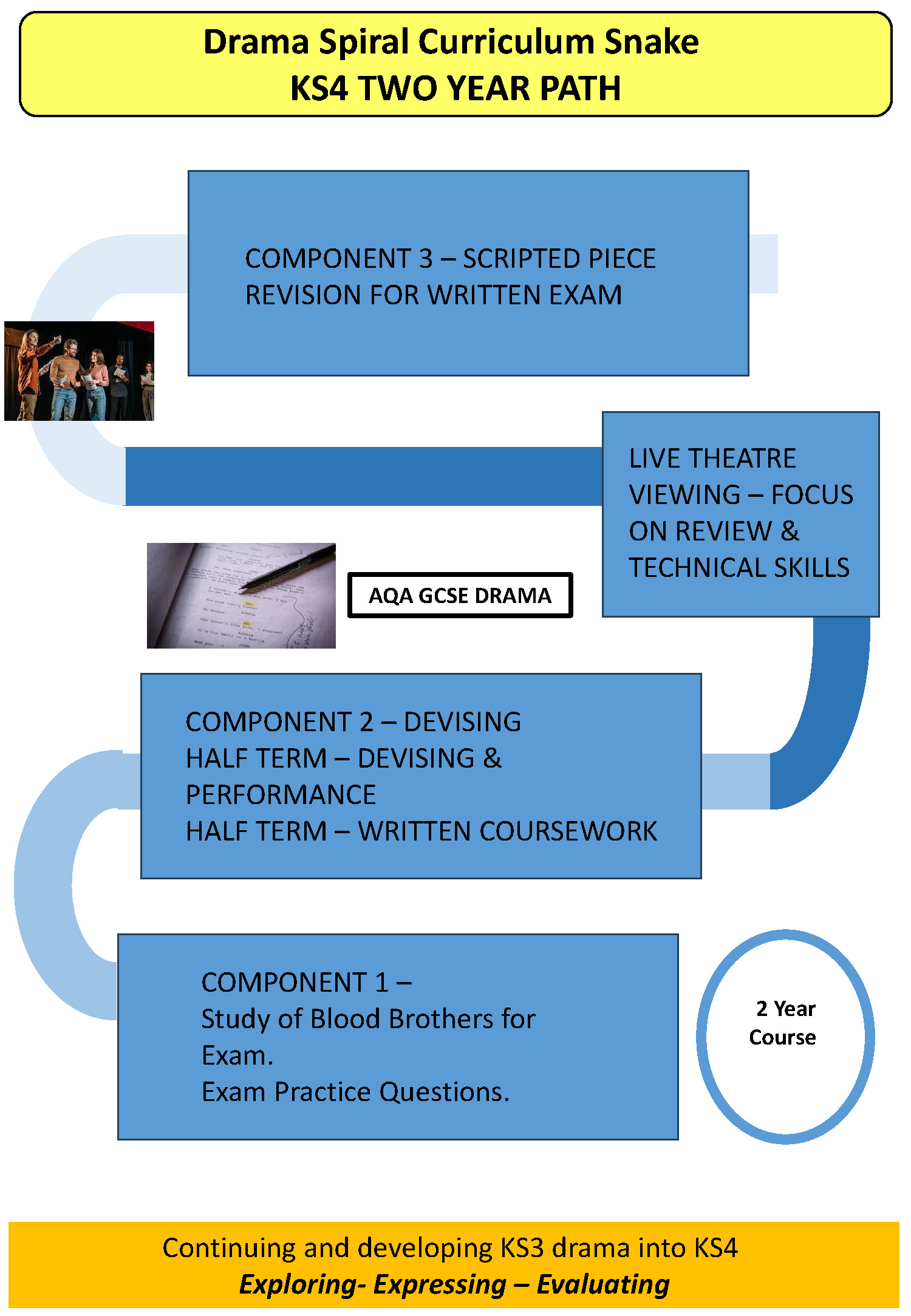
KS4: Students work at an advanced level, mastering technical and expressive skills. They study set texts, practitioner methods, and create sophisticated devised pieces using complex structures and conventions. Written analysis and evaluative skills are embedded to prepare for GCSE assessment.
This progression ensures that knowledge and skills are revisited and extended, moving from guided tasks to independent, creative projects. Each stage builds confidence, curiosity, and academic rigour, preparing students for further study and life beyond the stage.
Curriculum Pathways


Additional Opportunities Beyond the Classroom
- Productions
- Theatre visits