Geography
Geography underpins a lifelong 'conversation' about the earth as the home of humankind.
– Geography Association
Geography Curriculum Intent Statement
Our Geography curriculum aims to develop curious, informed, and responsible global citizens who understand the complexity of the world and their role within it. Through a rich and ambitious programme, we ensure that every student:
-
Thinks like a geographer: Students explore the big ideas of geography—Place, Scale, and Space; Physical and Human Processes; Interdependence; Environmental Interaction and Sustainable Development; Cultural Understanding and Diversity. These concepts underpin all learning, enabling students to make connections across topics and apply their knowledge to real-world challenges.
-
Understands the world and their place in it: Geography is about more than maps—it is about people, environments, and the relationships between them. Our curriculum helps students appreciate the uniqueness of places, from local landscapes to global regions, and understand how physical and human processes shape our lives.
-
Develops powerful knowledge and skills: Students learn to interpret data, analyse patterns, and evaluate solutions to complex problems. From questioning “Is Google Maps always right?” to exploring “Why do people live near volcanoes?”, enquiry drives our approach, fostering critical thinking and problem-solving skills.
-
Engages with contemporary issues: We tackle the big questions of our time—climate change, globalisation, resource management, and inequality—so that students can understand causes, consequences, and possible solutions. Topics such as “Are people destroying the world’s life support system?” and “Why are some countries richer than others?” encourage debate and informed decision-making.
-
Connects local, national, and global perspectives: From the geography of the UK to the rise of global superpowers, students learn how interconnected our world is. We link local contexts, such as Cornwall’s coastal challenges, to global processes like trade and migration, helping students see the relevance of geography in everyday life.
-
Prepares for life beyond school: Geography equips students with transferable skills—data analysis, spatial awareness, and critical thinking—that are valued in higher education and the workplace. More importantly, it nurtures an ethic of care for people and planet, empowering students to make sustainable choices.
Joy and curiosity: Lessons are enquiry-led, using thought-provoking questions such as “How lucky are we to live in a temperate climate?” or “Local benefits of deforestation are greater than global losses—discuss.”
Knowledge that sticks: We prioritise powerful knowledge and vocabulary, revisiting key concepts to secure long-term understanding.
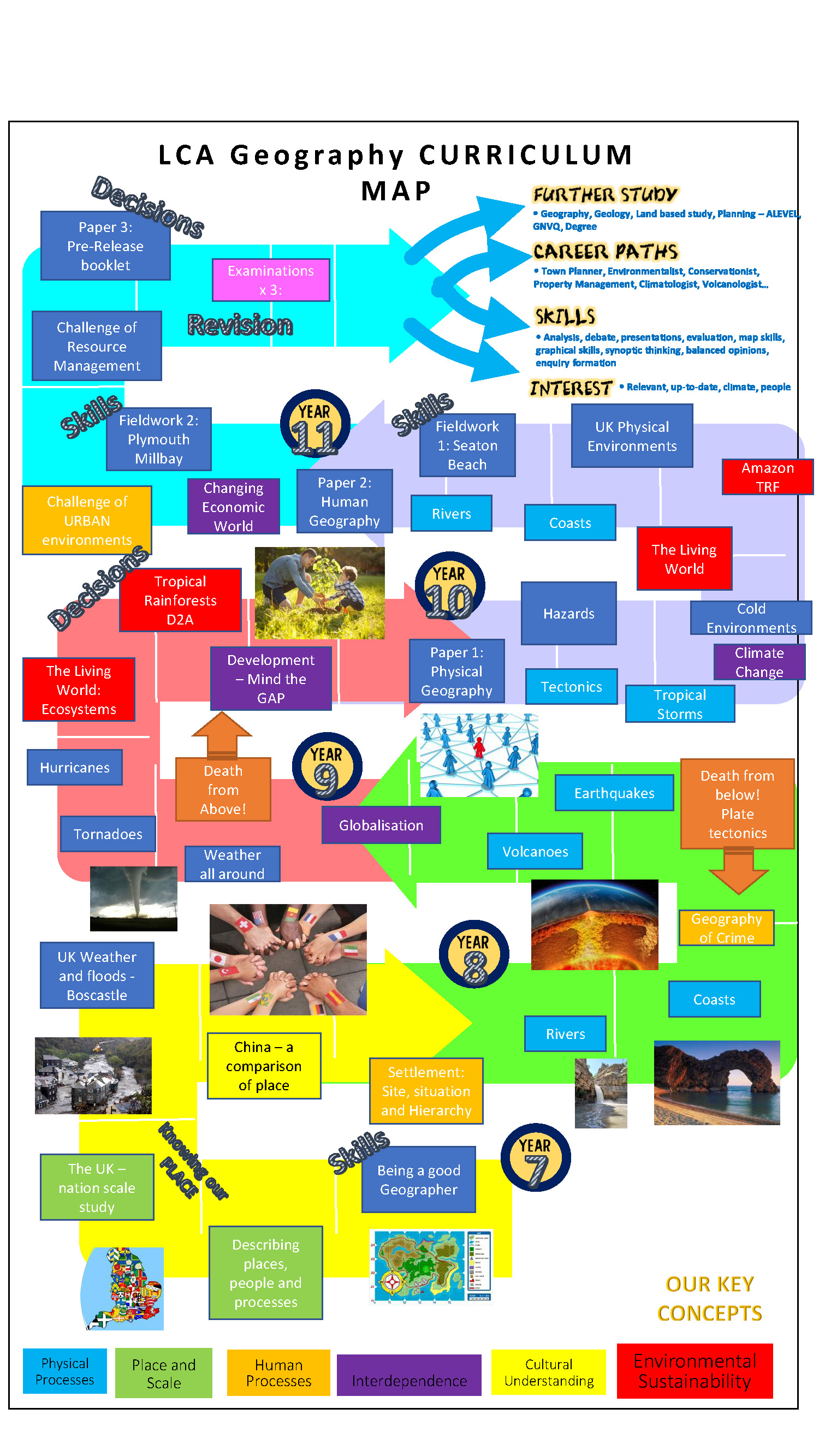
Curriculum Pathways
Additional Opportunities Beyond the Classroom
- Field trips